목차
스마트 안드로이드 미러란 무엇인가요?
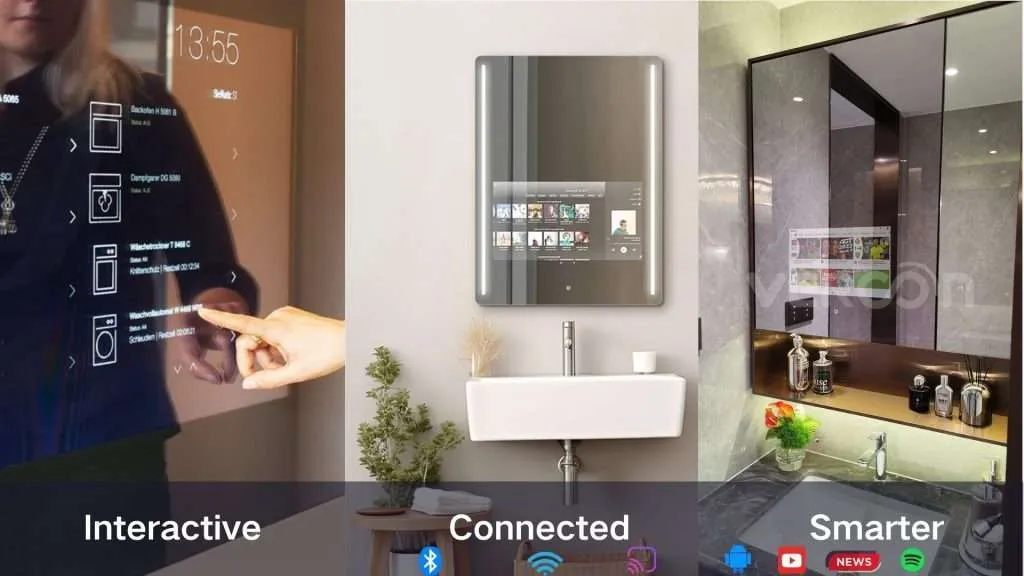
스마트 미러 글라스 - 스마트 미러의 보이는 비밀과 보이지 않는 비밀 - Vercon 스마트 미러 | 스마트 홈을 위한 올바른 선택 스마트 미러: 내장형 마이크로컴퓨터 장착, 터치스크린와 안드로이드 시스템을 결합하여 평범한 거울을 지능형 거울로 바꿔줍니다. 백설공주 동화에 나오는 거울이 현실이 되었다고 할 수 있습니다.
This mirror consists of both hardware and software components.
Hardware serves as the foundational support of the entire smart mirror, including familiar components such as the 마더보드, CPU, GPU, memory, and speakers. These smart hardware elements act as the mirror’s input and output devices, responsible for receiving commands and displaying processed results.
Today, we’ll focus on the software aspect of the smart mirror—specifically, the Smart Mirror with Android system. If hardware is the body of gold, then the software is the soul of the mirror.
스마트 미러의 소프트웨어
The operating systems for smart mirrors include Android, HarmonyOS, and Apple iOS. So far, Android is the most widely adopted platform in this field. Due to its uniquely closed ecosystem, Apple’s system has not yet been made available to the broader market.
Thanks to its open-source nature, Android has been highly favored in the smart mirror industry from the very beginning. And of course, as we all know, the original inventors of the smart mirror were none other than Google’s engineering team.
대화형 거울에서 안드로이드 시스템의 의미.
As we know, three essential elements define smart products: intelligent hardware, interactivity, and a smart operating system. Having already covered hardware and interactivity, what role does the smart system play?
The answer lies in its ability to integrate, process, and evolve:
Integration – It 하드웨어 연결 및 사용자 명령을 원활한 경험으로 전환합니다.
Processing – It transforms raw data (e.g., touch inputs, voice) into meaningful responses.
Evolution – Through updates and AI, it enables the mirror to grow smarter over time.
In short, if hardware is the body and interactivity the voice, the smart system is the brain—making decisions, learning habits, and turning a “mirror” into a “smart mirror.
스마트 앱 플랫폼.
The smart operating system serves as the critical link that interconnects intelligent 하드웨어 구성 요소, while also functioning as the platform for various applications.
To draw an analogy: Android constructs a virtual stage, and apps are the performers on that stage. As we know, all apps are developed based on Android or iOS code frameworks. Installing an Android system on a mirror essentially builds a digital platform on its display. All apps must operate on this platform to deliver their intended functionality.