Índice
Qual é o princípio da tecnologia de visualização do espelho inteligente? Sendo um produto inovador que combina a tecnologia de inteligência artificial com a funcionalidade dos espelhos tradicionais, os espelhos inteligentes estão gradualmente a transformar o nosso modo de vida. Não só aumentam a comodidade e o conforto, como também tornam a nossa vida mais inteligente e personalizada. Este artigo irá aprofundar a display principles of smart mirrors, uncovering the technological secrets behind them.
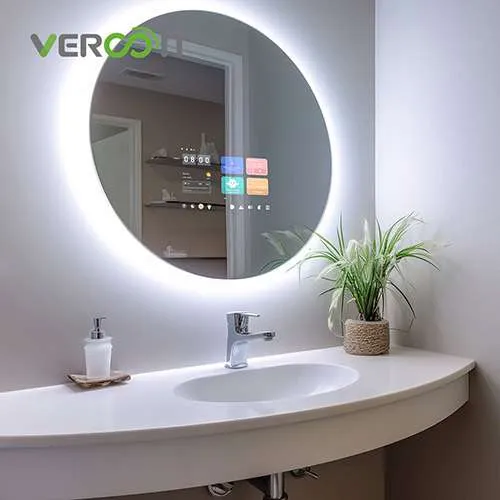
Smart Mirror Display Technology – the core component of the smart magic mirror
Display Screen: Typically employs high-brightness, low-power LCD or OLED screens to ensure clear information visibility even in well-lit environments. The key player in this industry is LG and BOE. which are the key supplier of Vercon Technology.
Mirror Layer: Positioned above the ecrã de visualização, it uses semi-transmissive and semi-reflective materials to make the screen content subtly visible within the mirror. This preserves the mirror’s basic functionality while allowing information display.
Processor: Responsible for processing data from sensors and voice recognition modules. As well as controlling content updates on the display screen.
Sensors: Include ambient light sensors, human proximity sensors, etc. It’s used to detect environmental changes and user proximity, automatically adjusting screen brightness and activating displays.
Voice Recognition Module: Enables the identification and processing of voice commands, allowing users to control the mirror through speech.
Power Management: Ensures the smart mirror operates in low-power mode while providing sufficient electricity to support screen display and processor functionality.
The display principle of smart mirrors
The display principle of smart mirrors is primarily based on the integration of reflection and camera technology. At its core lies the transparent reflective coating technology on the mirror surface. This technology enables smart mirrors to reflect the user’s image like a traditional mirror. While simultaneously capturing and transmitting the user’s image in real time to the built-in camera, creating a “virtual screen.” This design allows smart mirrors to function not only as mirrors but also as displays, presenting information from the smart system directly on the mirror surface. This achieves seamless human-machine interaction.
Others beyond the displays
Inside a smart mirror, display screen and sensor technologies are also integrated. The display screen is a key component for presenting information from the smart system, such as time, weather, and news. Sensors, on the other hand, detect user movements and environmental changes to trigger corresponding functions. For example, when a user approaches the smart mirror, the sensors can detect their proximity and automatically activate the display to show the desired information.
In addition to the display and sensors, smart mirrors are equipped with various artificial intelligence technologies, such as voice recognition, facial recognition, and semantic understanding. These technologies enable the smart mirror to accurately interpret user commands and needs, allowing it to quickly respond to a wide range of user requests. For instance, users can issue voice commands to check the weather, set alarms, or play music.
What can be displayed on the smart mirrors?
In practical applications, the display principles of smart mirrors are also reflected in their diverse functionalities. For example, a smart mirror can serve as a touchscreen display, showing basic information like time, date, and weather. It can also connect to sistemas domésticos inteligentes to display the status of other connected devices, such as indoor temperature, humidity, and air quality. By integrating with voice assistants, the smart mirror can receive and execute voice commands, such as setting alarms, playing music, or checking the news.
Some advanced versions of smart mirrors are also equipped with health monitoring features, such as heart rate detection, weight management, and skin analysis. Through simple operations, users can access their health data to better manage their well-being. Additionally, smart mirrors can serve as entertainment hubs by playing videos and music, or even facilitating video calls with family members. When integrated with smart home security systems, they can also display live surveillance footage, allowing users to monitor their home’s safety in real time.
In summary, the display principle of smart mirrors is based on a combination of reflection and camera technology. By leveraging displays, sensors, and artificial intelligence, they achieve seamless human-machine interaction and support a wide range of functional applications. As technology continues to advance and application scenarios expand, smart mirrors are expected to bring even more surprises and convenience to our lives in the future.
Setup Steps for the Schematic Diagram of Smart Magic Mirror Display
Conceção da ligação de hardware
Smart Mirror Display Technology’s Power Circuit Design:
Design an efficient power management circuit, including options for battery power and external power adapters, to ensure the smart mirror operates reliably under various conditions.
Display Screen and Processor Connection:
Connect the display screen to the processor using interfaces such as HDMI or MIPI DSI to ensure stable data transmission.
Mirror Layer Installation:
Secure the mirror layer above the display screen using specialized adhesives, maintaining an appropriate gap to ensure optimal display performance.
Sensor Integration:
Connect sensors to the processor via interfaces such as I2C or SPI to ensure accurate reading of sensor data.
Voice Recognition Module Connection:
Link the voice recognition module to the processor using UART or USB interfaces to enable the transmission and processing of voice commands.
Software Design and Configuration
Soul of Smart Mirror Display Technology – Operating System Selection:
Choose a suitable operating system (e.g., Linux, RTOS) based on the processor type to provide a stable foundation for upper-layer applications.
Driver Development:
Develop corresponding drivers for hardware components such as the display screen, sensors, and voice recognition module. It ensures effective communication with the operating system.
Application Layer Software Development:
Design the user interface to implement functions like information display and voice interaction. Utilize graphics libraries (e.g., Qt, OpenGL) for interface development and speech recognition libraries (e.g., Google Speech Recognition, CMU Sphinx) for voice command recognition.
Low-Power Management:
Implement power management strategies. Such as automatically adjusting screen brightness based on ambient light and entering sleep mode when not in use, to extend battery life.
Testing and Optimization
- Hardware Testing:
Verify the stability of connections and functional integrity of all hardware modules. - Software Testing:
Conduct functional, performance, and stability tests to ensure the software is bug-free and responsive. - User Experience Optimization:
Refine interface layouts and improve interaction logic based on testing feedback to enhance user experience.
Conclusão
The setup of the smart mirror display technology schematic is a complex process involving hardware connections, software design, user experience optimization, and other aspects. Through appropriate hardware selection, meticulous software design, and rigorous testing, a smart mirror product with rich features, stable performance, and an excellent user experience can be created. With the continuous advancement of IoT technology, smart mirrors will play an increasingly important role in the future smart home market, providing users with more convenient and intelligent living experiences.