Table of Contents
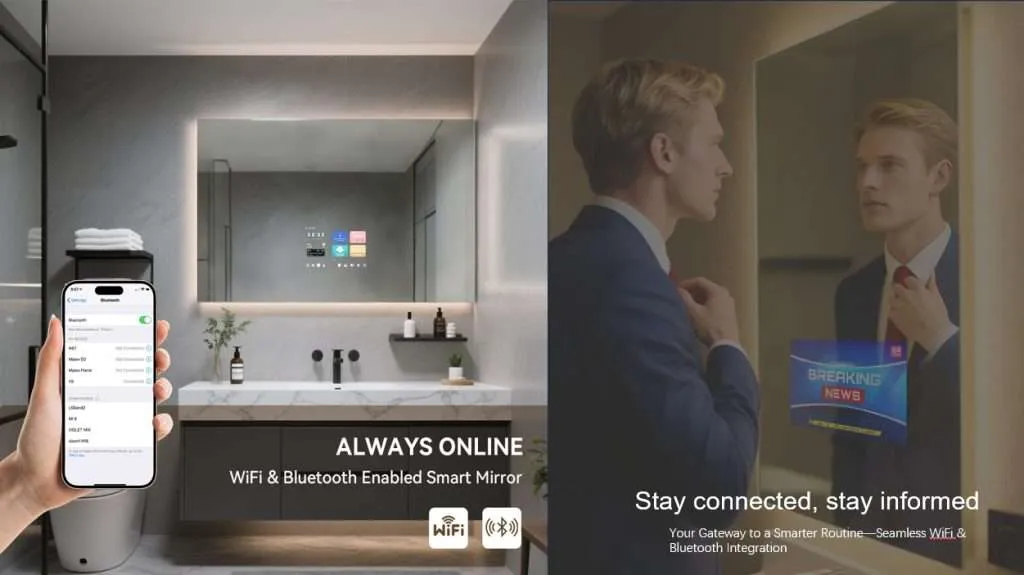
In our highly technologically advanced society, IoT has become an essential feature for innovative products. Mirrors, among the most frequently used items in daily life, none connective mirror appeared, have seemingly lagged in technological development. However, VERCON Technology’s Smart Mirror has now emerged to fill this market gap.
What is a connective mirror ?
In our conventional understanding, mirrors are reflective devices for daily use – dressing, grooming, and checking appearances. Traditionally, this product seems entirely unrelated to ‘connectivity’. Yet when our washing machines, refrigerators, and even light bulbs have embraced connective capabilities, the emergence of connective mirrors becomes an inevitable evolution.
One of good example – Orvibo Smart Mirror, ODM by Vercon Technology.
Bluetooth connected mirror
“Bluetooth Mirror” refers to a mirror equipped with a Bluetooth module, allowing it to connect to smartphones, iPads, or other smart devices via Bluetooth. In this setup, the mirror acts as a passive receiver (typically with built-in speakers).
The primary function of a Bluetooth mirror is music playback, enhancing the user experience with audio enjoyment. Compared to traditional LED mirrors, this technology transforms a static reflective surface into an interactive audio product—adding immersive ambiance and emotional value through music.
WIFI connected mirror
A WiFi smart mirror represents a functional upgrade from Bluetooth-enabled mirrors. By integrating a built-in WiFi module, it connects directly to the internet, expanding the mirror’s data stream from just a paired smartphone to the entire online ecosystem.
Unlike Bluetooth mirrors limited to audio playback, WiFi smart mirrors can access a broader range of real-time information, including:
- Time & weather updates
- News feeds & social media
- Multimedia content (videos, music, etc.)
Equipped with a display screen, these mirrors provide both audio and visual information, elevating the user experience from “hearing” to “seeing and interacting.
IOT Connective Mirror
As the most advanced smart mirror on the market, the IoT connective mirror surpasses basic Bluetooth or WiFi models by integrating multiple connectivity protocols—including Bluetooth, WiFi, infrared, and more. This transforms the mirror from a passive display into an active smart home hub.
Key Differentiators
- Multi-Protocol Connectivity
- Supports simultaneous connections with smart home devices, wearables, and security systems (e.g., adjusting lights via WiFi, syncing health data from Bluetooth wearables).
- Active Control Hub
- Unlike audio/video-focused mirrors, it initiates commands (e.g., locking doors via Zigbee, optimizing room temperature through IR).
- Centralized “Home Brain”
- Unifies fragmented IoT devices under one interface—mirroring the role of platforms like Apple HomeKit or Google Home, but with embedded interactivity.
In the short term, its growth relies on B2B applications (commercial and medical sectors), while long-term success hinges on overcoming cost-performance barriers in the consumer (B2C) market. Its potential is deeply intertwined with smart home and health tech industries. With the integration of AI, we can confidently predict that connective smart mirrors will inevitably become a mainstream market staple.
The Future Home’s Brain
We all agree that we live in a hyper-connected world. But have we truly realized that our homes have evolved into interconnected ecosystems? Beyond just a reflection, the Connected Mirror is emerging as the definitive “central brain” for the smart bathroom—and ultimately, the entire smart home. It is where human daily routines meet intelligent control.